The Founder Who Thought Grants Would Save the Business
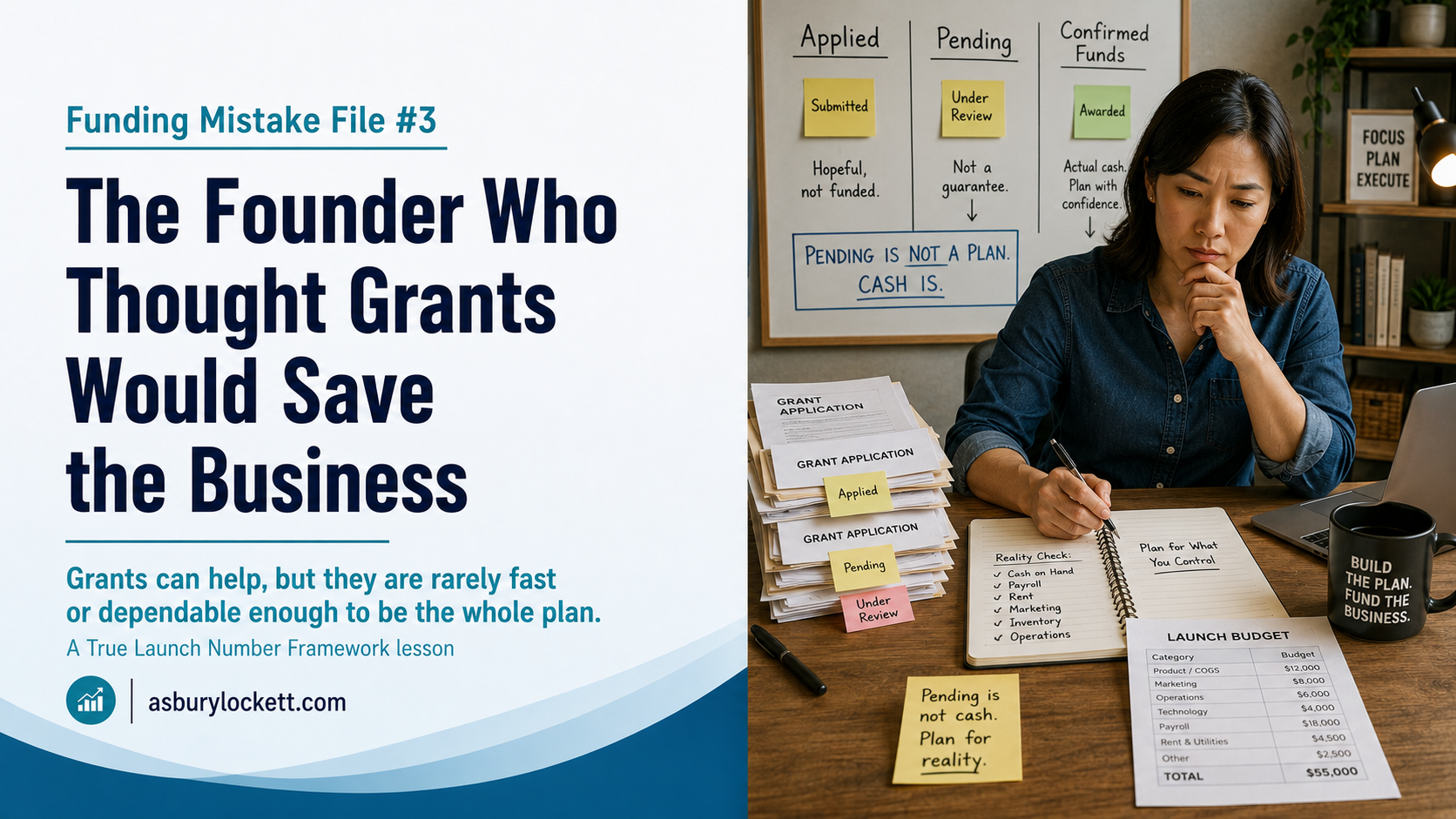
Lesson: Grants can help, but they are rarely fast or dependable enough to be the whole plan.
Author’s Note: The story below is fictional, but it is inspired by real patterns I have seen while advising small business owners. Names, industries, locations, dollar amounts, and other details have been changed, combined, or fictionalized to protect confidentiality.
Grants have a powerful appeal for first-time founders. Unlike loans, they do not usually require repayment. Unlike investors, they do not require giving up ownership. For a founder who is short on startup capital, a grant can sound like the perfect solution.
But grants are rarely simple, fast, or guaranteed.
Many grant programs are competitive. Some have narrow eligibility rules. Some reimburse expenses only after the founder has already spent the money. Others take months to review, award, document, and disburse. A founder may spend hours applying and still receive nothing. Even when a grant is awarded, the amount may not be enough to cover the full funding gap.
That lesson became clear for a fictional founder named Monique, who planned to open a neighborhood childcare enrichment center. She had a strong mission, community support, and a real need in the market. But she built too much of her launch plan around grants that had not yet been awarded.
1. The Founder’s Dream
Monique had spent most of her career working with young children. She had been a preschool assistant, after-school program leader, summer camp coordinator, and parent volunteer. Families trusted her because she was patient, organized, and genuinely committed to helping children feel safe, curious, and confident.
Over time, Monique noticed a gap in her neighborhood. Many working parents needed reliable after-school enrichment, homework help, reading support, and structured activities during school breaks. Traditional childcare centers were often full. Some tutoring centers were too expensive. Many parents wanted something more personal than a large program, but more structured than informal babysitting.
Monique imagined a small childcare enrichment center offering after-school care, literacy activities, creative projects, school-break camps, and parent workshops. Her dream was both practical and mission-driven. She wanted to help families, create jobs, and build a safe space for children who needed more support outside school hours.
Because her mission aligned with education, family support, and community development, people encouraged her to look for grants. A friend sent her a link to a local small business grant. A nonprofit director mentioned a child development funding opportunity. A city newsletter highlighted support for women-owned businesses. A community member told her, “There is a lot of money out there for this kind of thing.”
Monique began to believe grants could fund most of the launch.
She found several programs that seemed promising and started applying. At the same time, she moved forward with the business. She identified a small facility, began working on licensing requirements, priced furniture and supplies, designed a logo, and created program descriptions for parents.
She felt hopeful because the need was real and the mission was strong.
But hope about grants is not the same as confirmed capital.
2. The Mistake
Monique’s mistake was treating potential grant funding as if it were part of her available launch capital. She included hoped-for grant money in her mental budget before she had approval letters, signed agreements, or funds in hand.
That created a dangerous planning gap.
The facility needed lease deposits, insurance, safety improvements, furniture, learning materials, technology, licensing fees, background checks, marketing, staff training, cleaning supplies, and months of operating cash before enrollment would be stable. Monique knew these costs existed, but she assumed grants would cover much of the burden. Because of that assumption, she did not fully build an alternative funding plan.
She also underestimated the timing. One grant required a detailed application, budget narrative, community impact statement, and documentation of matching funds. Another grant would not announce awards for four months. A third required the business to be operating before reimbursement could occur. A fourth program looked promising at first, but Monique later discovered that her planned use of funds did not qualify.
Each grant had rules, timing, and uncertainty.
Monique was not wrong to pursue grants. Her mistake was depending on them before they were real.
3. The Impact
The impact became clear as launch expenses arrived faster than grant decisions. The landlord wanted a commitment. Licensing steps required payments. Contractors required deposits for safety improvements. Furniture and classroom supplies had to be ordered. Marketing needed to begin before enrollment could grow. Staff candidates wanted to know when the center would open.
Monique continued applying for grants, but applications took time. Each one required a slightly different budget, narrative, set of documents, and explanation of community impact. Instead of focusing fully on licensing, enrollment, operations, and parent outreach, she spent many late nights rewriting grant applications and searching for new opportunities.
Meanwhile, the cash gap widened.
One grant application was declined because the program had hundreds of applicants and limited funds. Another was delayed. A third asked for additional documentation. A fourth turned out to reimburse only certain approved costs after purchase, which did not help Monique pay upfront expenses. The result was not one dramatic failure, but a series of small delays and disappointments that left the launch underfunded.
Because Monique had counted on grants, she had not built enough runway from other sources. She used personal savings for expenses she expected a grant to cover. She put some items on credit cards. She delayed marketing. She postponed hiring decisions. She also considered opening with fewer staff and longer hours for herself, which would have increased exhaustion and operational risk.
The hardest part was emotional. Monique felt that the community needed the center, and people kept telling her the idea deserved support. That may have been true. But deserving support and receiving timely funding are different things. The business still needed a capital plan that could function even if grants did not arrive.
Her mission was strong.
Her funding plan was too dependent on uncertainty.
4. The Better Path
A True Launch Number™ analysis would have helped Monique place grants in the right role. Grants could be part of the funding strategy, but they should not be treated as the foundation unless they were awarded, documented, and timed to match the business’s needs.
The first step would have been to calculate the full launch-to-break-even cost without assuming grant approval. Monique needed to estimate facility costs, licensing, safety improvements, furniture, curriculum supplies, insurance, payroll, marketing, technology, owner needs, reserves, and early operating losses. This would show the real funding requirement before any uncertain outside money was counted.
The second step would have been to separate confirmed funds from hoped-for funds. Confirmed funds might include savings, committed contributions, approved loans, signed presales, or formally awarded grants. Hoped-for funds might include grants applied for, grants under consideration, future donations, or possible sponsorships. Keeping those categories separate would prevent Monique from spending as if uncertain funds were guaranteed.
The third step would have been to evaluate grant timing and restrictions. If a grant would not announce awards for four months, it should not be used to cover a lease deposit due next week. If a grant reimburses expenses after payment, Monique still needs upfront cash. If a grant can only be used for equipment, it cannot solve payroll. If a grant requires matching funds, the match must be included in the capital plan.
The fourth step would have been to build a backup funding strategy. Monique might combine a smaller launch, customer deposits, tuition presales, a limited pilot program, family support with written terms, a small line of credit, community sponsorships, or a phased facility plan. Grants could still help, but the business would not collapse if they were delayed or denied.
The fifth step would have been to use grants strategically rather than desperately. Instead of applying to every possible program, Monique could prioritize grants that matched her stage, timeline, eligibility, and funding uses. A grant for outdoor learning materials might support program quality. A workforce grant might help with staff training. A women-owned business grant might help with equipment. Each grant would be treated as helpful support, not as the entire survival plan.
A better path might have led Monique to start with a smaller after-school pilot in a shared community space, build enrollment, collect deposits, prove demand, and then use grant applications to expand. That approach would give funders a stronger story and reduce the risk that the business was waiting on uncertain money to open.
The goal is not to ignore grants.
The goal is to avoid building a launch plan that fails if grants do not arrive.
5. The True Launch Takeaway
Grants can help, but they are rarely fast or dependable enough to be the whole plan. A founder should pursue grants with discipline, but not confuse eligibility with approval, application with award, or award with immediate cash.
Monique’s story is a reminder that a strong mission does not eliminate the need for a strong capital plan. Community value matters. Social impact matters. Founder commitment matters. But rent, payroll, supplies, licensing, marketing, and owner living needs still require cash at specific times.
The True Launch Number™ Framework helps founders see where grants fit within the larger funding picture. It helps separate confirmed funds from hoped-for funds, immediate needs from future opportunities, and restricted dollars from flexible working capital. That distinction can protect the founder from making commitments based on money that may not arrive in time.
Before counting grant money, founders should ask: Has the grant been awarded? When will funds be available? What can the money be used for? Are reimbursements required? Is a match required? What happens if the grant is delayed or denied? What funding gap remains without it?
Those questions do not make the founder less hopeful.
They make the plan more resilient.
Before you wait on grants, know what must be funded now.
Before you commit to expenses, separate confirmed money from possible money.
Before you launch, make sure your True Launch Number™ works even if grants take longer than expected.
Next Step
Want to avoid this mistake in your own startup?
Download the free True Launch Number™ Checklist to begin identifying your startup costs, monthly expenses, early operating losses, owner needs, cash reserves, and funding gap before you commit to a launch plan.
For a deeper step-by-step process, my book,Securing Small Business Startup Funding, walks first-time founders through how to calculate the real amount of capital needed to move from idea to launch to break-even.
