What is a True Launch Number™?
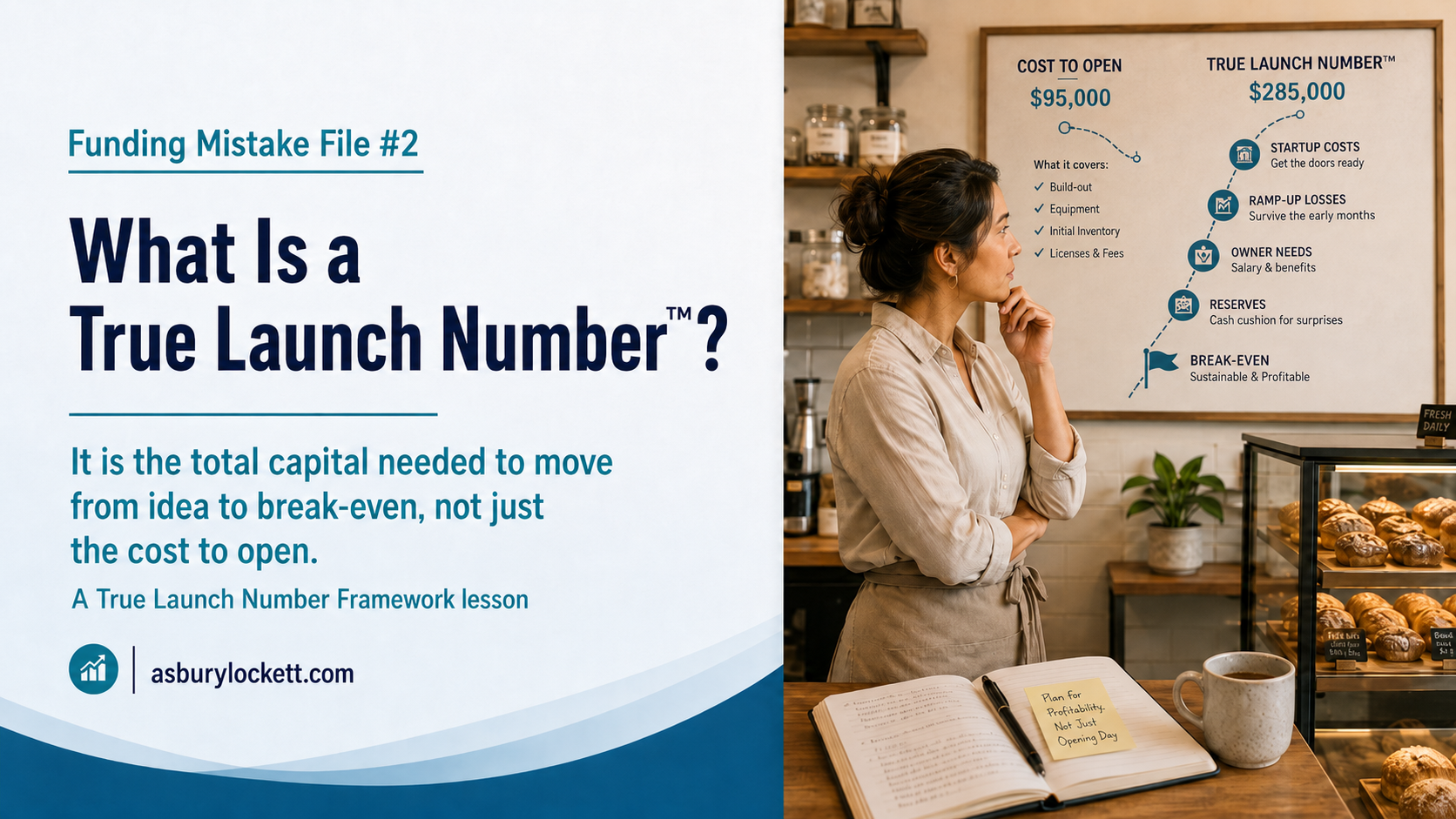
Lesson: It is the total capital needed to move from idea to break-even, not just the cost to open.
Author’s Note: The story below is fictional, but it is inspired by real patterns I have seen while advising small business owners. Names, industries, locations, dollar amounts, and other details have been changed, combined, or fictionalized to protect confidentiality.
Many first-time founders ask a version of the same question: “How much will it cost to start my business?” That is a reasonable question, but it is usually too small.
The better question is: “How much capital will I need to move from idea to launch to break-even?”
That broader number is what I call the True Launch Number™.
The True Launch Number™ is not just the amount needed to open the doors, build the website, buy equipment, order inventory, or host a launch event. It is the fuller amount of capital needed to give the business a realistic chance to reach the point where revenue can cover ongoing costs. That means it includes startup costs, early operating losses, working capital, owner needs, reserves, and the cash needed to survive while customers, sales, systems, and revenue are still developing.
That lesson became clear for a fictional founder named Olivia, who wanted to open a small neighborhood bakery. She was careful, talented, and serious about the business. But her first estimate focused on what it would cost to open, not what it would cost to reach break-even.
1. The Founder’s Dream
Olivia had been baking for years. She started with birthday cakes and holiday desserts for family, then began taking custom orders for friends, coworkers, and local events. Her specialty was small-batch baked goods with a personal touch: cupcakes, breakfast pastries, cookies, celebration cakes, and seasonal dessert boxes. Customers loved the quality, and many told her that her products tasted better than anything they could buy at a grocery store.
Over time, Olivia began to imagine opening a small bakery café. She pictured a warm neighborhood space with display cases, fresh coffee, morning pastries, custom cake orders, and weekend dessert boxes. She wanted the business to feel local, friendly, and high-quality without being overly formal. She also hoped the bakery could eventually provide jobs for a few people in the community.
Olivia found a small retail space near a residential area with schools, offices, and weekend foot traffic. The location felt promising. The landlord was willing to offer a short build-out period, and the prior tenant had left some usable fixtures. Olivia began estimating what she needed to open.
She listed the obvious items: lease deposit, first month’s rent, kitchen equipment, display cases, signs, permits, insurance, furniture, packaging, ingredients, a point-of-sale system, website, branding, and opening marketing. After gathering quotes and making estimates, she concluded that she needed about $95,000 to open the bakery.
That number became the goal. She planned to use savings, family support, a small loan, and personal credit to reach it.
The estimate was not careless. Olivia had done more planning than many founders do. But the estimate still had a major weakness.
It was the cost to open.
It was not the True Launch Number™.
2. The Mistake
Olivia’s mistake was thinking that the amount required to open the bakery was the same as the amount required to launch the business successfully. She was focused on the visible costs of becoming operational. Those costs were real and important, but they did not tell the full story.
The bakery would not reach break-even on the first day. Customers would need time to discover it, try it, return, place larger orders, and build new habits. Morning traffic might start slowly. Custom cake orders might take months to become steady. Catering and office orders would require outreach. Online reviews would need to build. Staff would need training. Waste would need to be managed. Pricing would need adjustment.
During that ramp-up period, expenses would continue every month. Rent, utilities, insurance, payroll, ingredients, packaging, loan payments, marketing, cleaning, repairs, software, taxes, and owner living needs would all require cash. Some expenses would be higher than expected because the business was new and still learning. There would be mistakes, slow days, spoilage, equipment issues, and marketing experiments that did not work.
Olivia’s $95,000 opening estimate did not fully include those early operating losses. It did not include enough owner living support. It did not include a cash reserve for delays or repairs. It did not include enough marketing beyond the launch period. It did not include a realistic cushion for the time it would take the bakery to reach steady weekly sales.
Her number answered the question, “What do I need to open?”
It did not answer the question, “What do I need to survive until the business can support itself?”
3. The Impact
The bakery opened beautifully. Friends, family, and curious neighbors came during the first week. Social media photos looked polished. Customers complimented the pastries and the design of the space. Olivia felt proud because the dream had become real.
But after the opening excitement faded, the daily numbers became uneven. Some mornings were busy, while others were slow. Weekend dessert boxes sold well, but weekday foot traffic was unpredictable. Custom cake inquiries came in, but many customers wanted lower prices or longer lead times. Office catering seemed promising, but businesses did not place orders immediately. Olivia realized that building repeat customer behavior would take more time than expected.
The bakery also had more cash demands than she had planned for. Ingredient costs fluctuated. Some products sold out too early, while others had to be discarded. Payroll was difficult because she needed help during peak hours, even when total sales were not yet high enough to support a full staff. A refrigerator repair created an unexpected expense. Marketing required more than one opening announcement. The bakery needed ongoing visibility, partnerships, local outreach, email capture, reviews, and seasonal promotions.
Because Olivia had raised enough to open but not enough to reach break-even, cash became tight by the fourth month. She began making short-term decisions. She reduced marketing to preserve cash. She delayed hiring help, which left her exhausted. She used credit cards for inventory and repairs. She took little money home, which created pressure in her household. She considered adding more products to increase sales, but that increased complexity and waste.
The bakery was not a bad idea. Customers liked it. The location had potential. Olivia had skill and commitment. But the business needed more runway than she had funded.
Her launch number had been incomplete.
4. The Better Path
A True Launch Number™ analysis would have changed Olivia’s planning before she signed the lease, bought equipment, or committed to the full opening plan. It would have helped her identify the total capital needed to move from idea to launch to break-even.
The first step would have been to calculate startup costs. Olivia had already done part of this work. She needed to know the cost of deposits, build-out, equipment, furniture, signs, permits, insurance, branding, website setup, initial inventory, packaging, and opening marketing. These are the costs most founders think about first, and they matter.
The second step would have been to calculate monthly operating costs. Olivia needed to know what the bakery would cost to run each month after opening. That means rent, utilities, payroll, ingredients, packaging, cleaning, insurance, software, bookkeeping, marketing, loan payments, taxes, repairs, and owner needs. This number would help her understand the size of the monthly burden.
The third step would have been to estimate the sales ramp. Instead of assuming that sales would quickly reach the needed level, Olivia could create conservative, moderate, and optimistic scenarios. How much would the bakery sell in month one, month two, month three, and beyond? How long would it take to develop repeat morning traffic, custom cake orders, dessert boxes, catering, and seasonal sales? What if sales grew more slowly than expected?
The fourth step would have been to identify the break-even point. Olivia needed to know the monthly sales level required to cover the bakery’s operating costs. If the bakery needed $32,000 per month to break even, then the plan should show how the business would realistically reach that number and how long it might take.
The fifth step would have been to calculate the cash gap before break-even. If the bakery lost $12,000 in month one, $10,000 in month two, $8,000 in month three, and smaller amounts in later months, those losses had to be funded. They were not signs of failure by themselves. They were part of the launch path. But if they were not included in the capital plan, they would become a crisis.
The sixth step would have been to include owner living needs and reserves. Olivia needed to know how she would pay personal expenses while the bakery matured. She also needed a cushion for repairs, delays, waste, slow sales, and unexpected problems. A founder who has no reserve is forced to make decisions under pressure.
Once all of those items were included, Olivia may have discovered that the bakery’s True Launch Number™ was not $95,000. It might have been $145,000, $175,000, or more. That larger number might have caused her to raise more capital, choose a smaller location, delay the café seating area, start with preorders and farmers markets, negotiate better lease terms, reduce equipment purchases, or open in phases.
That is the value of the True Launch Number™. It does not automatically tell the founder to spend more. It tells the founder the truth earlier, when there is still time to make better decisions.
5. The True Launch Takeaway
A True Launch Number™ is the total capital needed to move from idea to break-even, not just the cost to open. It includes the visible startup costs, but it also includes the less visible costs that often determine survival: early operating losses, working capital, marketing after launch, owner living needs, reserves, and the cash needed to survive the sales ramp.
Olivia’s story is a reminder that opening a business and launching a business are not the same thing. Opening is the moment the doors unlock, the website goes live, or the first product becomes available. Launching is the larger process of building enough customer demand, revenue, systems, and stability to reach break-even.
Many founders underfund their businesses because they stop the calculation too early. They estimate what it takes to start, but not what it takes to survive. They plan for the grand opening, but not the quiet Tuesday three months later when rent is due, payroll is due, marketing still needs money, and sales are not yet where they need to be.
The True Launch Number™ helps founders ask better questions. What will it cost to open? What will it cost to operate each month? How long will it take to reach break-even? What losses will occur before then? How much owner support is needed? What cash reserve is necessary? What funding gap remains after available resources are counted?
Those questions help the founder decide whether to raise more money, reduce the scope, launch in phases, delay commitments, change the model, or seek a different funding mix.
Before you ask how much it costs to start, ask how much it costs to reach stability.
Before you fund opening day, fund the path to break-even.
Before you launch, know your True Launch Number™.
Next Step
Want to avoid this mistake in your own startup?
Download the free True Launch Number™ Checklist to begin identifying your startup costs, monthly expenses, early operating losses, owner needs, cash reserves, and funding gap before you commit to a launch plan.
For a deeper step-by-step process, my book, Securing Small Business Startup Funding, walks first-time founders through how to calculate the real amount of capital needed to move from idea to launch to break-even.
