The Founder Who Confused Startup Cost with Launch Cost
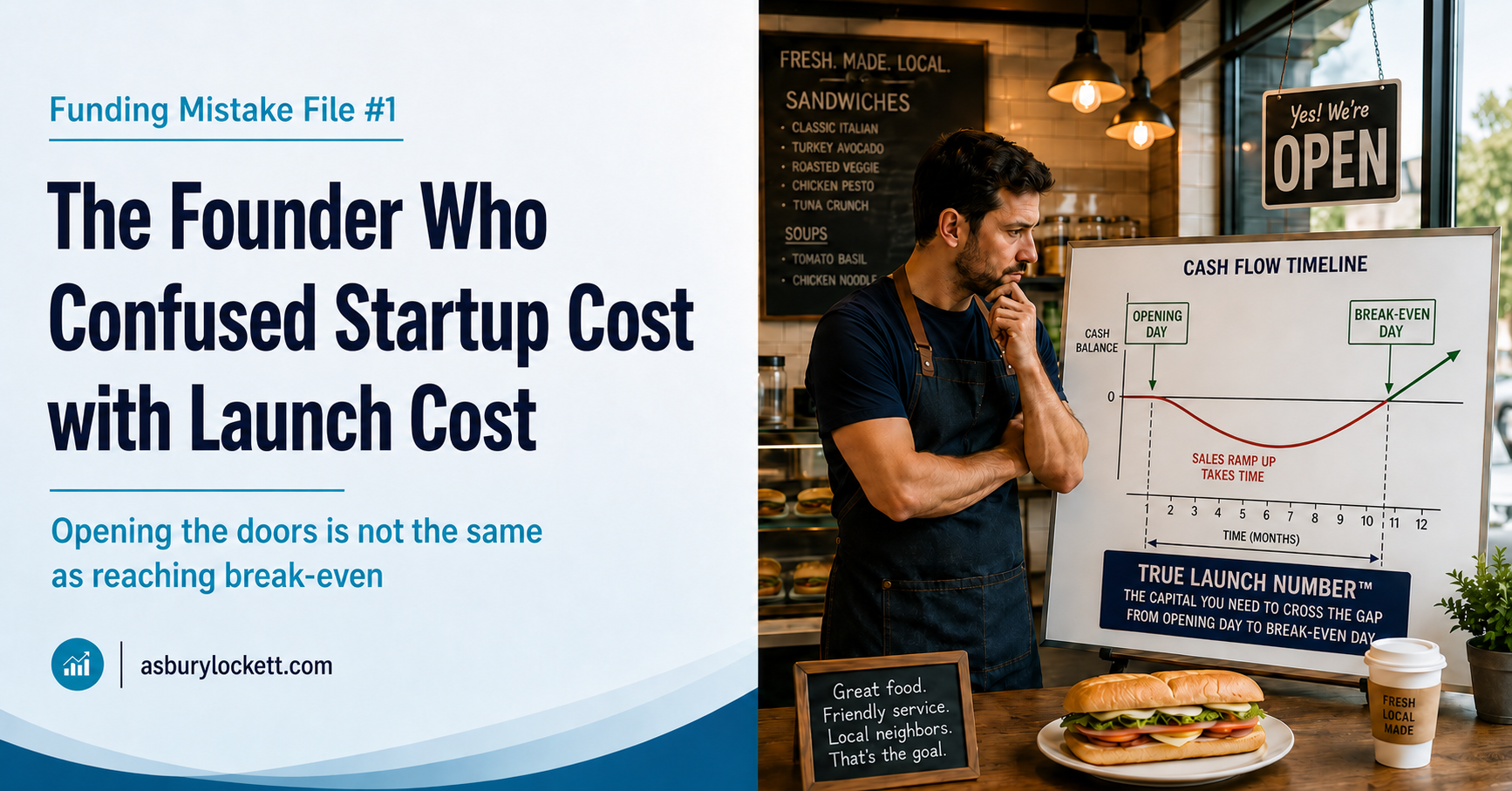
Lesson: Opening the doors is not the same as reaching break-even.
Author’s Note: The story below is fictional, but it is inspired by real patterns I have seen while advising small business owners. Names, industries, locations, dollar amounts, and other details have been changed, combined, or fictionalized to protect confidentiality.
Many first-time founders ask a reasonable question: “How much will it cost to start my business?” That question matters, but it is often incomplete. It usually leads the founder to think about the cost of getting ready to open: equipment, deposits, permits, inventory, signs, website, insurance, furniture, supplies, and other visible startup expenses.
But opening the doors is not the same as reaching break-even.
A business can be fully opened and still be financially fragile. Customers may arrive slowly. Revenue may take months to become predictable. Marketing may require more time and money than expected. The owner may need personal income before the business can safely provide it. Expenses may begin immediately, while sales take time to build. If the founder only funds the cost to open, the business may run out of cash before it has a fair chance to stabilize.
That lesson became clear for a fictional founder named Marcus, who opened a specialty sandwich shop. He had a good product, a promising location, and a clear dream. But his funding estimate stopped at opening day, while the business needed capital all the way to break-even.
1. The Founder’s Dream
Marcus had wanted to own a food business for years. He had worked in restaurants when he was younger, enjoyed creating recipes, and loved the idea of building a place where customers could get fresh, satisfying meals without the feel of a fast-food chain. His idea was a neighborhood sandwich shop with homemade soups, seasonal specials, quality bread, fresh ingredients, and quick service for office workers, nearby residents, and weekend visitors.
The dream felt practical. Marcus was not trying to create an expensive fine-dining concept. He wanted a focused menu, friendly service, and strong lunch traffic. He believed that if he found the right location and controlled the menu carefully, the business could become a steady local favorite. Friends encouraged him. Family members told him his food was good enough to sell. A few former coworkers said they would become regular customers if he ever opened a shop.
After searching for months, Marcus found a small storefront near several offices and a busy street. The rent was higher than he originally wanted, but the location had visibility and foot traffic. The space needed work, but not a complete rebuild. Marcus began estimating what he would need to open: lease deposit, first month’s rent, kitchen equipment, tables, chairs, signage, permits, insurance, opening inventory, a point-of-sale system, menu boards, packaging, and a basic website.
After gathering quotes and making his best estimates, he concluded that he needed about $85,000. He put in personal savings, borrowed some money from family, used credit cards for smaller purchases, and secured a small loan to cover the rest. It was stressful, but he reached the number he had set.
When the shop opened, Marcus felt proud. The sign was up. The counter was ready. The menu was printed. The first customers walked in. In his mind, he had funded the business.
But he had really funded the opening.
The launch was just beginning.
2. The Mistake
Marcus’ mistake was confusing startup cost with launch cost. His estimate focused on what it would take to open the doors, but it did not fully include what it would take to keep the doors open until the business could support itself.
The difference is important. Startup cost is the cost to get ready. Launch cost is the broader cost of moving from idea to opening to break-even. Startup cost gets the business into existence. Launch cost gives the business time to become stable.
Marcus had not fully planned for the ramp-up period. He expected sales to build quickly because the location looked strong and the food was good. He assumed office workers would discover the shop within the first few weeks, become regular customers, and spread the word. He also believed that once revenue started coming in, it would help cover rent, payroll, ingredients, loan payments, marketing, and his own basic needs.
Those assumptions were not unreasonable, but they were too optimistic. The shop needed time to become part of customers’ routines. Some office workers brought lunch from home. Some walked past several times before trying it. Some customers liked the food but only came once a week. Catering opportunities took longer to develop. Online reviews started slowly. Marcus also discovered that lunch traffic was highly concentrated during a short window, which made staffing and food prep harder to manage.
He had money for equipment, furniture, and the opening inventory. But he did not have enough money for several months of operating losses, continued marketing, food waste while learning demand, staff training, owner living support, repairs, and cash reserves.
He had calculated the cost to start.
He had not calculated the cost to reach break-even.
3. The Impact
The first month brought excitement and encouragement. Friends, family, curious neighbors, and nearby workers came in to try the new shop. Marcus received compliments on the food, and a few customers returned more than once. The opening felt successful enough to confirm that the idea had potential.
By the second month, the early excitement slowed. The shop still had customers, but not enough consistent daily volume to cover all expenses. Some days were strong, especially when nearby offices were full. Other days were quiet. Rain affected foot traffic. A few large companies nearby had hybrid work schedules, which meant lunch demand was less predictable than Marcus expected. The shop was open and operating, but sales were not yet steady.
Expenses did not wait for sales to mature. Rent was due every month. Ingredients had to be purchased before meals were sold. Payroll had to be covered even when customer traffic was uneven. Loan payments began. Utilities, insurance, software, packaging, cleaning supplies, repairs, and taxes all required cash. Marcus also needed to take some money home, but the business could not yet afford to pay him consistently.
As pressure increased, Marcus began making decisions that weakened the business. He reduced marketing because cash was tight, even though more visibility was needed. He delayed hiring help, which left him exhausted and slowed service during lunch rushes. He bought less inventory to preserve cash, which sometimes caused popular items to sell out too early. He accepted catering orders at prices that were too low because he wanted revenue, but those orders consumed time and labor without enough margin.
The emotional impact was heavy. Marcus felt confused because the food was good and customers were not rejecting the business. The problem was not lack of effort or lack of passion. The problem was that the business needed more time and cash to reach stability than he had planned.
Opening day had been real.
But break-even was still far away.
4. The Better Path
A True Launch Number™ analysis would have helped Marcus see the full funding need before opening. Instead of asking only, “What will it cost to open the sandwich shop?” he would have asked, “What will it cost to move from idea to opening to break-even?”
The first step would have been to calculate startup costs. Marcus had already started this process by listing lease deposits, equipment, furniture, signage, permits, insurance, inventory, website setup, packaging, and opening marketing. Those items were necessary, but they were only the first part of the funding picture.
The second step would have been to calculate monthly operating costs. Marcus needed to know what the shop would cost to run each month after opening. That included rent, payroll, ingredients, packaging, utilities, insurance, software, marketing, cleaning, maintenance, loan payments, taxes, and owner living needs. Once he knew the monthly cost, he could calculate how much sales volume the business needed to carry itself.
The third step would have been to estimate a realistic sales ramp. Rather than assuming customers would come quickly, Marcus could have built conservative, moderate, and optimistic projections. A conservative ramp might show slow customer discovery, limited catering, uneven weekday traffic, and gradual repeat business. That forecast would reveal how much cash the shop might lose before sales reached break-even.
The fourth step would have been to calculate the break-even point. If the shop needed $38,000 in monthly sales to cover expenses, Marcus needed to know what that meant in daily customers, average ticket size, lunch volume, catering orders, and repeat visits. Without that number, he could not tell whether his early sales were on track or how far the business still had to climb.
The fifth step would have been to calculate the cash gap before break-even. If the shop was likely to lose money for six to nine months, those losses needed to be funded before launch. That amount, plus startup costs, owner needs, reserves, and working capital, would become part of the True Launch Number™.
Once Marcus saw the full number, he would have had options. He might have raised more capital, negotiated better lease terms, opened with a smaller menu, delayed certain equipment purchases, started with catering and pop-ups before signing a lease, built office relationships before opening, or created a stronger marketing reserve. He might also have decided that the location was too expensive for the expected ramp-up period.
The better path was not necessarily to abandon the business. It was to understand the full journey before committing to the launch.
A founder who knows the True Launch Number™ can make better decisions before cash gets tight.
5. The True Launch Takeaway
Opening the doors is not the same as reaching break-even. A business can look ready, serve customers, receive compliments, and still be financially vulnerable if the founder only funded the cost to start.
Marcus’ story is a reminder that the opening is just one milestone. The more important survival milestone is break-even, when the business can cover its ongoing costs from its own revenue. Until that point, the business needs enough runway to keep operating, keep marketing, keep learning, and keep improving.
This is why the True Launch Number™ matters. It expands the funding question from “What will it cost to open?” to “What will it cost to reach break-even?” That broader question includes startup costs, ramp-up losses, monthly burn, working capital, owner living needs, reserves, and the time required for sales to become stable.
Before launching, founders should ask: What will it cost to open? What will it cost to operate each month? How long will sales realistically take to ramp? What is the break-even point? How much cash will be lost before then? What reserve is needed if things take longer than expected? What funding gap remains after available resources are counted?
Those questions may reveal a larger number than the founder first expected. But that is not bad news. It is useful news. It gives the founder time to raise more money, reduce costs, stage the launch, negotiate better terms, or redesign the model before the business is under pressure.
Before you open the doors, know what it will take to keep them open.
Before you fund startup costs, fund the path to break-even.
Before you launch, know your True Launch Number™.
Want the Complete Step-by-Step Process?
Securing Small Business Startup Funding: A First-Time Founder’s Guide to Raising the Right Capital—from Idea to Break-Even, helps first-time founders calculate the capital needed to move from idea to launch to break-even—and develop a practical plan for obtaining it.
Next Step
Want to begin identifying your startup costs, monthly expenses, early operating losses, owner needs, cash reserves, and possible funding gap?
Download the free True Launch Number™ Checklist.
The checklist will help you begin thinking through the amount of capital your business may need before you commit to a launch plan.
