What Belongs in a Startup Capital Plan?
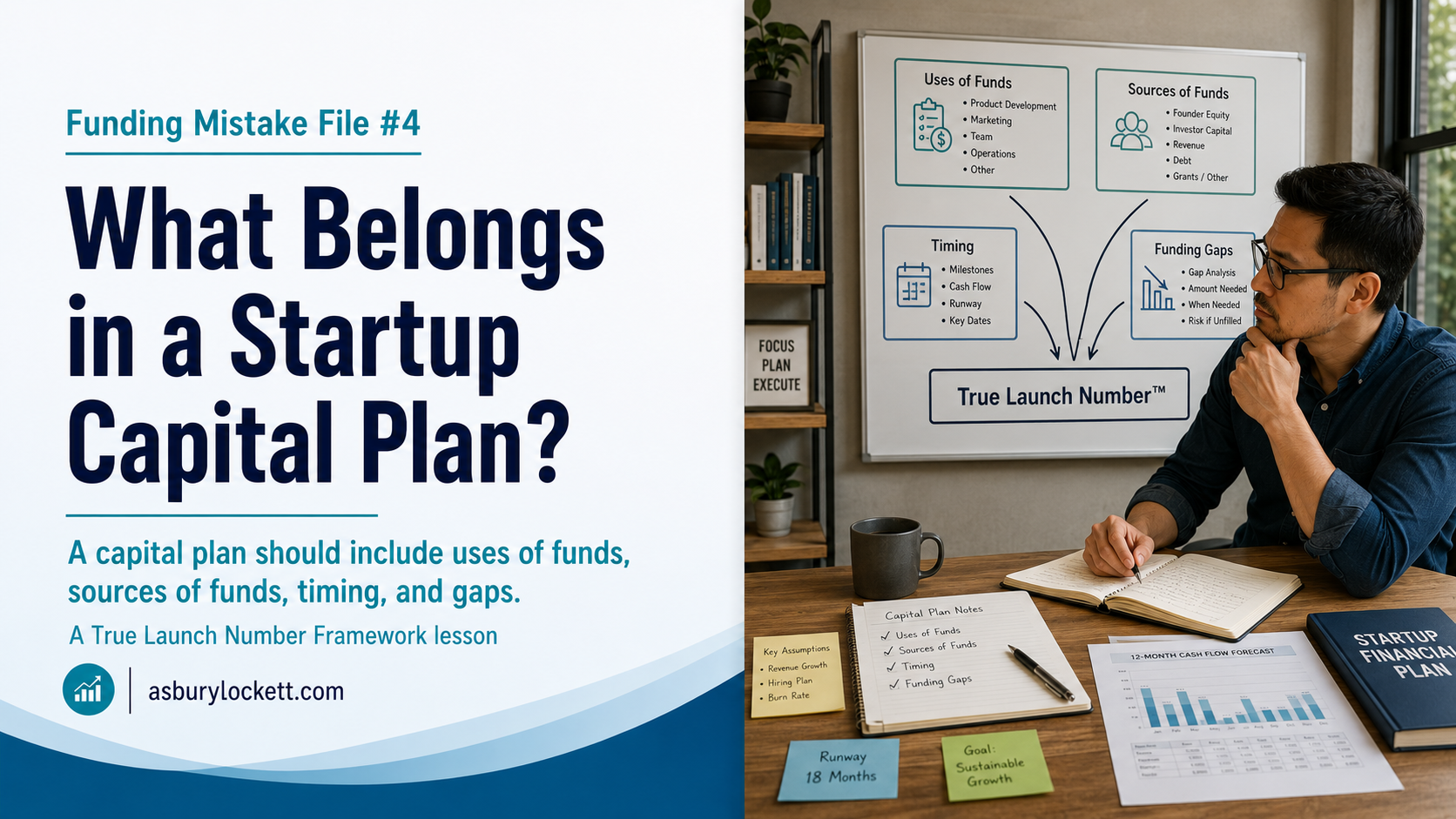
Lesson: A capital plan should include uses of funds, sources of funds, timing, and gaps.
Author’s Note: The story below is fictional, but it is inspired by real patterns I have seen while advising small business owners. Names, industries, locations, dollar amounts, and other details have been changed, combined, or fictionalized to protect confidentiality.
Many first-time founders think of funding as one large question: “How much money do I need?” That question matters, but it is only the beginning. A stronger startup funding conversation asks several related questions: What will the money be used for? Where will the money come from? When will the money be needed? What gap remains after available funds are counted?
Those questions form the foundation of a startup capital plan.
A capital plan is not just a list of startup expenses. It is a map that connects the founder’s launch strategy to the money required to execute it. It should show uses of funds, sources of funds, timing of funds, and funding gaps. Without those pieces, the founder may raise too little, borrow too early, spend in the wrong order, or commit to expenses before the right capital is available.
That lesson became clear for a fictional founder named Henry, who wanted to open a small home-repair and handyman business. He had useful skills, real customer demand, and a practical service model. But his early funding plan was really just a shopping list, not a true capital plan.
1. The Founder’s Dream
Henry had spent much of his working life around construction, maintenance, and repair. He could fix doors, patch drywall, install shelves, repair fences, replace fixtures, assemble furniture, paint rooms, and handle the small jobs many homeowners needed but did not want to do themselves. Friends and neighbors regularly asked him for help because he was reliable, careful, and clear about what he could and could not do.
Over time, Henry saw a business opportunity. Many homeowners struggled to find someone willing to handle smaller repair jobs. Contractors often preferred larger projects. Property managers needed quick turnaround. Busy families needed help with maintenance tasks that piled up over time. Older homeowners wanted someone trustworthy for basic repairs and safety improvements.
Henry imagined building a home-repair business focused on dependable service, clear pricing, and repeat customers. He wanted to start with small repair jobs, then grow into maintenance packages for homeowners, rental property owners, and real estate agents preparing homes for sale. He did not need a storefront, but he did need a reliable vehicle, tools, insurance, marketing, scheduling software, uniforms, a website, and cash to support the business while jobs became steady.
Henry began estimating costs. He listed a used work van, ladders, tools, insurance, business registration, website, logo, flyers, uniforms, software, and a small advertising budget. He estimated that he needed about $45,000 to get started.
That number gave him confidence. It seemed manageable. He had some savings, a credit card, and a relative who might help. He planned to “figure out the rest” as the business grew.
But Henry’s estimate was missing the structure a capital plan requires.
2. The Mistake
Henry’s mistake was confusing a startup expense list with a startup capital plan. His list showed some things the business needed to buy, but it did not answer the larger funding questions.
First, he had not clearly organized the uses of funds. Some items were essential before launch, such as insurance, basic tools, registration, and transportation. Other items could wait, such as extra specialty tools, upgraded branding, and paid advertising beyond the first test campaigns. Without separating must-have costs from later-stage costs, Henry risked spending too much upfront on items that did not immediately help the business reach paying customers.
Second, he had not identified sources of funds clearly. He knew he had some savings and available credit, and he thought a family member might help. But he had not written down how much was confirmed, how much was uncertain, what terms applied, or whether the money was a loan, gift, credit line, or owner contribution. He was mentally counting money that had not yet been committed.
Third, he had not thought through timing. A work van and insurance were needed early. Some tools could be purchased as jobs required them. Marketing might need steady spending over several months, not just a launch burst. Owner living expenses would continue while the business built a customer base. If all funds were spent before revenue stabilized, Henry would have no cushion.
Fourth, he had not calculated the funding gap. He estimated that the business needed $45,000, but he had not compared that amount against confirmed resources, projected early losses, owner needs, and reserves. The real gap could be larger or smaller depending on how he staged the launch.
His plan answered, “What might I need to buy?”
It did not answer, “How will I fund the launch in the right order and still have enough runway to reach break-even?”
3. The Impact
Henry launched with energy and quickly discovered that money decisions came faster than expected. He found a used van that seemed like a good deal, but it needed repairs and shelving. He bought more tools than he needed at first because he wanted to look professional and be ready for any job. He paid for a logo, website, printed flyers, online directory listings, insurance, business registration, and branded shirts.
The spending felt reasonable item by item. Together, it consumed much of his available cash.
In the first few months, Henry received calls and booked jobs, but the work was inconsistent. Some weeks were busy. Others were slow. A few jobs required materials upfront, and customers reimbursed him later. One property manager wanted net-30 terms. A homeowner delayed payment because they wanted an additional repair completed first. The van needed another repair. Fuel costs were higher than expected because jobs were spread across a wider area than Henry had planned.
Because he had not built the capital plan around timing, Henry began using credit cards to cover gaps. He still had customers and revenue, but the cash was not flowing in a smooth pattern. He also realized that some of the money spent upfront could have been delayed. The extra specialty tools sat unused while he struggled to fund marketing and basic working capital.
When Henry later approached a lender, the conversation was harder. The lender asked how much money he needed, how it would be used, what he had already invested, what revenue looked like, and how much working capital remained. Henry could explain the business, but his funding history looked scattered. He had spent from savings, charged items to credit cards, accepted small family help, and purchased equipment without a clear sources-and-uses plan.
The business was viable, but the capital plan was messy.
That made every later funding decision harder.
4. The Better Path
A True Launch Number™ analysis would have helped Henry build a real capital plan before spending the money. The plan would not need to be complicated, but it would need to answer four questions: uses, sources, timing, and gaps.
The first part is uses of funds. Henry would list what the money is needed for and organize those uses by category. For example: vehicle, essential tools, insurance, business setup, marketing, software, working capital, owner living needs, and reserves. He would also separate launch-essential expenses from later-stage expenses. That distinction matters because not everything the business eventually needs must be purchased before the first customer is served.
The second part is sources of funds. Henry would identify where the money will come from: owner savings, family loan, business loan, credit card, equipment financing, customer deposits, presold maintenance packages, or early revenue. Each source should be labeled as confirmed or uncertain. If money is borrowed from family, the terms should be written down. If credit cards are used, repayment pressure should be included. If equipment financing is used, payments should be included in monthly burn.
The third part is timing. Henry would decide when each use of funds is required. Some money is needed before launch. Some is needed during the first three months. Some is needed only if the business grows. Timing helps prevent the founder from spending too much too soon. It also helps the founder see when cash shortages may occur, even if the total funding amount appears adequate.
The fourth part is the gap. After uses, sources, and timing are mapped, Henry can see what remains unfunded. The gap might show that he needs an additional $20,000 before signing up for a van loan. Or it might show that he can launch safely with less money if he delays nonessential tools and uses customer deposits for materials. The gap is not always bad. It is useful information. It tells the founder what must be solved before moving forward.
A better path for Henry might have included buying only essential tools at launch, leasing or financing the van more carefully, requiring deposits for materials, creating prepaid seasonal maintenance packages, saving a working capital reserve, and using marketing dollars in stages based on what produced calls. He might also have documented family support as a small loan with clear repayment expectations instead of treating it informally.
The True Launch Number™ Framework would bring all of these pieces together. It would help Henry see not only how much money he needed, but what the money was for, when it was needed, where it would come from, and what shortfall remained.
That is the difference between having a list of costs and having a capital plan.
5. The True Launch Takeaway
A startup capital plan should include uses of funds, sources of funds, timing, and gaps. If any of those pieces are missing, the founder may not have a complete view of the launch.
Henry’s story is a reminder that money problems do not always come from having no plan at all. Sometimes they come from having only part of a plan. A founder may know what they want to buy, but not which purchases should come first. They may know who might provide money, but not whether that money is confirmed. They may know the total estimated cost, but not when each expense hits. They may believe the business is funded, but not see the hidden gap until cash gets tight.
A capital plan turns funding into a sequence of decisions. It helps founders decide what to buy now, what to delay, what to finance, what to fund with savings, what to cover with customer deposits, and what gap must be solved before launch. It also makes conversations with lenders, investors, advisors, and family supporters clearer.
The True Launch Number™ is strongest when it is supported by a capital plan. The number tells the founder the total capital needed to reach break-even. The capital plan explains how that number will be funded and used.
Before you spend, know the use.
Before you borrow, know the source.
Before you launch, know the timing, the gap, and your True Launch Number™.
Next Step
Want to avoid this mistake in your own startup?
Download the free True Launch Number™ Checklist to begin identifying your startup costs, monthly expenses, early operating losses, owner needs, cash reserves, and funding gap before you commit to a launch plan.
For a deeper step-by-step process, my book, Securing Small Business Startup Funding, walks first-time founders through how to calculate the real amount of capital needed to move from idea to launch to break-even.
