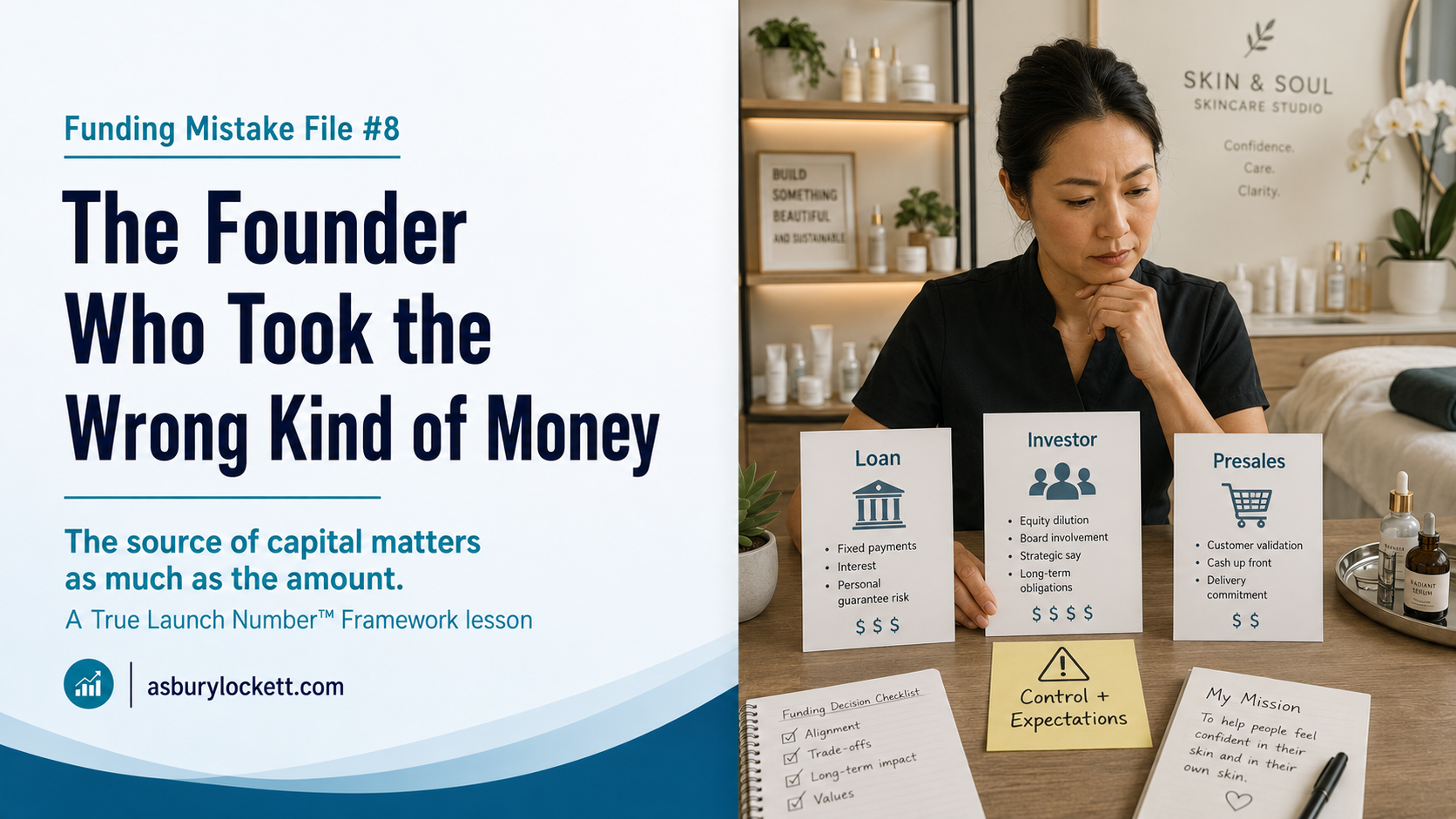
Lesson: The source of capital matters as much as the amount.
Author’s Note: The story below is fictional, but it is inspired by real patterns I have seen while advising small business owners. Names, industries, locations, dollar amounts, and other details have been changed, combined, or fictionalized to protect confidentiality.
Many first-time founders focus almost entirely on whether they can get money. That is understandable. When a founder needs capital to move forward, any available funding can feel like progress. A loan approval, a family contribution, a credit card limit increase, or an investor’s interest can feel like the door is finally opening.
But not all money solves the same problem.
Some capital is useful for equipment. Some is better for inventory. Some can support working capital. Some should be reserved for marketing and ramp-up losses. Some money comes with fixed payments. Some comes with ownership expectations. Some comes with emotional pressure. Some may be fast but expensive. Some may be cheaper but slower. The wrong kind of money can create pressure before the business has had time to become stable.
That is the lesson learned by a fictional founder named Keisha, who launched a commercial cleaning company with real customer demand, strong work ethic, and early sales momentum — but used a form of financing that did not match the timing of her cash flow.
1. The Founder’s Dream
Keisha had worked in facilities management for more than a decade. She understood cleaning standards, staffing schedules, supply needs, customer expectations, and the difference between a job that looked clean and one that was actually performed well. Over the years, she noticed that many small offices, clinics, and professional buildings were unhappy with their cleaning providers. Some companies were inconsistent. Others undertrained workers. Some were difficult to reach when problems came up.
Keisha believed she could do better.
Her vision was to build a dependable commercial cleaning company serving small professional offices, medical-adjacent businesses, and local service companies. She wanted to compete on reliability, communication, and quality control rather than simply being the cheapest provider. She planned to start with evening cleaning contracts, then add day porter services, specialty deep cleaning, and eventually small facility maintenance support.
The opportunity felt realistic because Keisha already had industry knowledge and several warm relationships. A former colleague introduced her to an office manager who needed a new cleaning provider. A local dental office expressed interest. A small accounting firm asked for a bid. Keisha felt encouraged because she was not starting with only an idea. She had potential customers who needed exactly what she planned to offer.
To get started, she needed money for business registration, insurance, bonding, cleaning equipment, uniforms, supplies, transportation, background checks, payroll setup, marketing materials, and enough working capital to hire help before customers paid invoices. Because commercial clients often paid on net-30 or net-45 terms, Keisha also needed cash to cover payroll and supplies before revenue came in.
She estimated that $40,000 would be enough to get launched. When a lender offered her a short-term business loan with quick approval and daily repayment withdrawals, she accepted. The money arrived fast, and Keisha felt relieved. She bought equipment, stocked supplies, paid for insurance, hired two part-time workers, and moved quickly to service her first accounts.
For a few weeks, it felt like the loan had solved the problem.
Then the payment structure became the problem.
2. The Mistake
Keisha’s mistake was not borrowing money. Her mistake was using the wrong kind of money for the stage and cash-flow pattern of her business.
The loan she accepted was fast, but it was expensive and rigid. Repayments began almost immediately. The lender withdrew money from her business account every business day, regardless of whether customers had paid their invoices. That structure might have worked better for a business with steady daily cash receipts, such as a retail store or restaurant with consistent card sales. But Keisha’s commercial cleaning company did not receive money daily. It performed work, sent invoices, and waited.
That timing mismatch created pressure.
Keisha needed working capital, not just startup cash. She needed money that could cover payroll, supplies, and operating costs while invoices were outstanding. Instead, she took money that required repayment before her revenue cycle had stabilized. The business was generating sales, but the cash was not arriving fast enough to match the repayment schedule.
She had also failed to compare funding sources based on purpose. Equipment purchases could have been financed one way. Working capital could have been handled another way. Owner savings, a line of credit, invoice factoring, slower growth, customer deposits, or better payment terms might have reduced the pressure. Instead, she used one expensive short-term loan to cover everything.
The source of capital did not fit the use of capital.
That difference mattered.
3. The Impact
At first, Keisha’s sales activity looked promising. She signed two small monthly contracts and one larger office-cleaning account. She also received a one-time deep cleaning job that produced good revenue. On paper, the business appeared to be gaining traction. The issue was cash timing.
Her workers expected to be paid every two weeks. Supply vendors required payment quickly. Fuel costs were immediate. Insurance premiums and software fees were due on schedule. Meanwhile, customers paid after invoices were processed. One client paid late because the office manager was out. Another required vendor onboarding before payment could be released. The larger account paid on a 45-day cycle, which was normal for them but difficult for Keisha.
The loan withdrawals did not wait.
Every business day, money left the account. Some days the amount seemed manageable. Other days it felt painful. When a customer payment came in, a portion of it was quickly consumed by loan repayment, past-due supplies, payroll obligations, and the next round of operating costs. Keisha began to feel like the business was busy but never catching up.
The stress changed her decision-making. She delayed hiring another worker even though she needed help to take on new jobs. She accepted a low-margin contract because she needed cash flow, even though the job required more labor than expected. She cut back on marketing because the loan payments made her nervous. She used personal credit cards to bridge payroll during one tight week, which added another layer of financial pressure.
The most frustrating part was that Keisha’s business was not failing from lack of demand. Customers liked the service. Referrals were beginning. The problem was that the financing structure was draining cash before the business could build stability.
She had obtained capital.
But the capital came with terms that did not match her operating reality.
4. The Better Path
A True Launch Number™ analysis would have helped Keisha identify not only how much capital she needed, but what type of capital was appropriate for each part of the launch.
The first step would have been to separate startup costs from working capital needs. Startup costs included business setup, equipment, insurance, branding, uniforms, supplies, and initial marketing. Working capital included payroll, fuel, supplies, insurance, owner needs, and other expenses during the period before invoices were paid. These are related needs, but they do not always require the same funding source.
The second step would have been to map the cash-flow cycle. Keisha needed to understand when work would be performed, when invoices would be sent, when customers were likely to pay, and when payroll and other expenses would be due. If clients paid in 30 to 45 days but payroll was due every two weeks, the business needed a cushion large enough to cover that gap.
The third step would have been to evaluate funding options based on timing and flexibility. A daily repayment loan may provide fast cash, but it can be dangerous for a business with delayed receivables. A line of credit might have been better because it could be used only when needed and repaid when invoices were collected. Invoice financing might have helped once she had reliable commercial accounts. Customer deposits or partial upfront payments might have reduced the gap. Equipment leasing could have spread out equipment costs without using working capital. A smaller launch with fewer contracts might have allowed Keisha to grow at a pace her cash flow could support.
The fourth step would have been to consider the true cost of money. The interest rate or fee is important, but so is the repayment schedule. A loan with weekly or daily payments can be much harder to manage than a loan with monthly payments, even if the total amount seems similar. For a startup, the timing of repayment can be as important as the dollar amount borrowed.
The fifth step would have been to test the funding source against the path to break-even. Would this money help the business reach stability, or would the repayment pressure reduce marketing, hiring, quality, and flexibility before the business had enough revenue? That question could have prevented Keisha from accepting the fastest available money simply because it was available.
A better path might have combined several strategies. Keisha could have used savings for setup costs, negotiated client deposits for the first month of service, requested shorter payment terms from new customers, leased some equipment, arranged a modest line of credit, and delayed hiring until contracts were confirmed. She might also have built a larger cash reserve before accepting larger accounts with slow payment cycles.
The goal would not have been to avoid debt entirely. The goal would have been to match the capital source to the capital need.
5. The True Launch Takeaway
The source of capital matters as much as the amount. A founder who needs $40,000 should not only ask, “Can I get $40,000?” The founder should also ask, “What kind of $40,000 do I need?”
That question changes everything.
Money used to buy equipment may need different terms than money used to cover payroll. Money used to fund inventory may need different timing than money used to survive a slow sales ramp. Money from family may require clear expectations. Money from investors may affect control. Credit cards may offer speed but carry high costs. Short-term loans may provide fast access but create repayment pressure. Grants may be attractive but uncertain and slow. Each source carries its own risks, benefits, timing, and obligations.
Keisha’s story is a reminder that getting funded is not the same as being properly funded. A business can receive money and still be financially fragile if the repayment terms do not match the business model. The wrong kind of money can force the founder to make decisions that weaken the business before it reaches break-even.
The True Launch Number™ Framework helps founders think beyond the total amount needed. It also helps them think about the right mix of funding sources, the timing of those funds, and the cost of each commitment. The purpose is not simply to raise money. The purpose is to build a capital plan that gives the business a fair chance to reach stability.
Before you accept money, understand what problem that money is supposed to solve.
Before you borrow, understand when the business can realistically repay.
Before you launch, know both your True Launch Number™ and your best funding mix.
Next Step
Want to avoid this mistake in your own startup?
Download the free True Launch Number™ Checklist to begin identifying your startup costs, monthly expenses, early operating losses, owner needs, cash reserves, and funding gap before you commit to a launch plan.
For a deeper step-by-step process, my book, Securing Small Business Startup Funding, walks first-time founders through how to calculate the real amount of capital needed to move from idea to launch to break-even.
