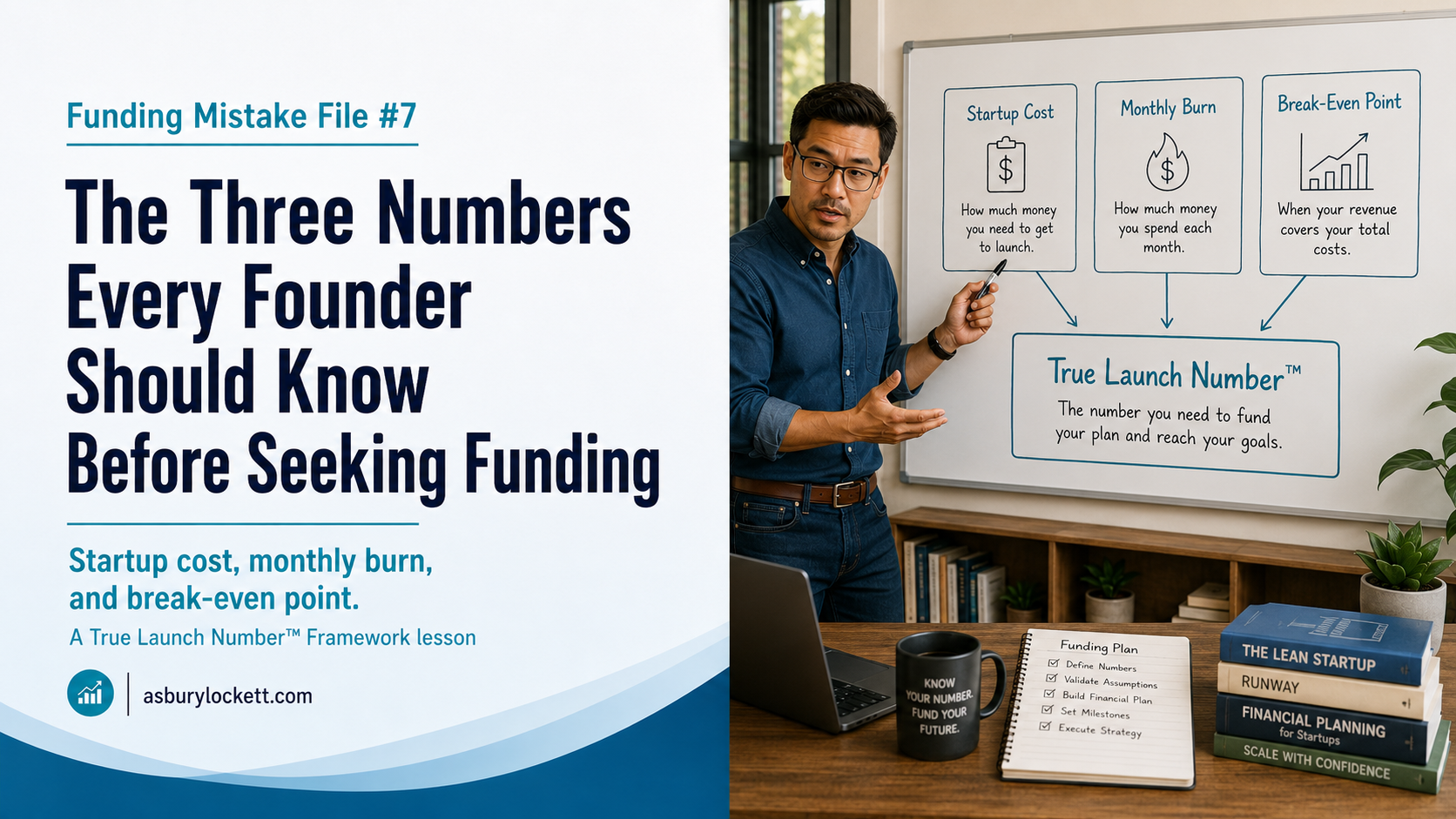
Lesson: Startup cost, monthly burn, and break-even point.
Author’s Note: The story below is fictional, but it is inspired by real patterns I have seen while advising small business owners. Names, industries, locations, dollar amounts, and other details have been changed, combined, or fictionalized to protect confidentiality.
Many first-time founders believe they need funding before they know their numbers. They know they need money, but they do not always know how much, how long it must last, or what milestone it must help them reach. That uncertainty makes funding conversations harder than they need to be.
Before seeking funding, every founder should know at least three numbers: startup cost, monthly burn, and break-even point.
Startup cost tells the founder what it takes to get the business ready to operate. Monthly burn tells the founder how much cash the business is likely to use before it becomes self-sustaining. Break-even point tells the founder what level of sales is needed for the business to cover its ongoing costs.
Together, these three numbers help form the foundation of the True Launch Number™.
That lesson became clear for a fictional founder named Malik, who wanted to open a small neighborhood juice bar and smoothie shop. He had energy, community support, and a product people liked, but his first funding conversations lacked the clarity that lenders and supporters needed to hear.
1. The Founder’s Dream
But it was still too low. Malik had spent years working in retail management while developing a personal interest in health, nutrition, and fitness. He was not a nutritionist, and he did not pretend to be one. But he loved helping people make better everyday choices, and he noticed that many people in his neighborhood wanted quick, healthier options that were not overly complicated or expensive.
He began making smoothies for friends after workouts and experimenting with fresh juices, protein blends, fruit bowls, and simple meal replacement drinks. People responded well. They liked that his recipes tasted good without feeling like “health food punishment.” Malik started imagining a small juice bar near a gym, a yoga studio, and a cluster of apartment buildings. His vision was to create a friendly neighborhood stop for morning smoothies, post-workout drinks, light snacks, and grab-and-go wellness products.
The dream felt realistic because the area already had foot traffic. There were fitness customers nearby, commuters in the morning, and residents who wanted convenient options. Malik also believed the business could grow through memberships, loyalty cards, delivery partnerships, office wellness orders, and local events.
He found a small retail space that seemed like a good fit. It had plumbing, a service counter, and enough room for equipment, refrigeration, storage, and a few seats. The landlord wanted a lease commitment quickly, and Malik began thinking seriously about funding. He talked with a lender, asked relatives whether they might help, and considered using some personal credit.
When people asked how much he needed, Malik usually said, “I think around $80,000 to $100,000 should get me started.”
That answer sounded reasonable, but it was not enough.
He knew he needed money.
He did not yet know the three numbers that should have shaped the request.
2. The Mistake
Malik’s mistake was trying to seek funding before clearly calculating startup cost, monthly burn, and break-even point. He had a general estimate, but each part of the estimate was incomplete.
His startup cost estimate included some obvious items: lease deposit, first month’s rent, blenders, refrigeration, signage, point-of-sale system, permits, insurance, initial inventory, furniture, branding, and website setup. But he had not gathered firm quotes for several items. He had not fully accounted for plumbing adjustments, electrical work, small equipment, health department requirements, menu boards, packaging, cleaning supplies, staff training, professional fees, or pre-opening marketing.
His monthly burn was even less clear. Malik knew rent would be due each month, and he knew he would have to buy fruit, vegetables, protein powder, cups, lids, straws, and other supplies. But he had not calculated the full monthly cost of keeping the business open. Utilities, payroll, payroll taxes, insurance, software, marketing, repairs, waste, loan payments, delivery platform fees, bookkeeping, and his own living needs all had to be included.
His break-even point was mostly a guess. Malik knew he needed to “sell a lot of smoothies,” but he had not calculated how many transactions per day were needed at his average price and margin. He did not know whether the business needed 50 customers per day, 90 customers per day, or 140 customers per day to cover expenses. Without that number, he could not tell whether his sales goals were realistic.
The problem was not that Malik lacked passion or ability. The problem was that his funding request was not yet tied to a clear financial path.
He was asking for money before the numbers could explain the need.
3. The Impact
The lack of clarity affected Malik almost immediately. When he spoke with a lender, the lender asked how much money he was requesting and how the money would be used. Malik gave a broad range and explained the general concept. The lender then asked for projections, sources and uses of funds, monthly operating costs, expected gross margin, and break-even sales volume.
Malik could answer some questions, but not confidently. He knew the product, the customer, and the neighborhood. He could describe the brand and the opportunity. But when the conversation turned to numbers, his plan became less specific.
Family conversations were also difficult. One relative was willing to contribute, but asked whether $10,000 would make a meaningful difference. Malik could not clearly say whether that contribution would cover equipment, working capital, marketing, or only part of the build-out. Another relative asked when the business might start paying Malik. He had not calculated that either.
The lease decision became stressful because Malik did not know how much runway he needed. If he signed the lease and the build-out took longer than expected, how much cash would be consumed before opening? Once open, how many slow months could the business survive? If sales started at half the expected level, how long would his funds last? If the startup cost came in higher than expected, would he still have enough money left for marketing and working capital?
Because he did not know the three numbers, every decision felt like a gamble. He considered trimming the opening budget, but did not know which cuts would help and which would hurt. He thought about borrowing more, but did not know the correct amount. He considered opening quickly to start generating sales, but did not know whether rushing would create operational mistakes.
Malik was not unprepared because he lacked a dream.
He was unprepared because the dream had not yet been translated into numbers that could guide decisions.
4. The Better Path
A True Launch Number™ analysis would have helped Malik build the funding request from the ground up. Instead of starting with a broad estimate, he would start with three essential numbers.
The first number is startup cost. Malik would list every cost required to get the juice bar ready to operate: lease deposits, construction, plumbing, electrical work, permits, equipment, refrigeration, signage, furniture, insurance, licenses, technology, branding, website setup, opening inventory, packaging, cleaning supplies, menu boards, professional fees, and launch marketing. This would show what it takes to open properly.
The second number is monthly burn. Malik would estimate how much cash the business would use each month before reaching break-even. That includes rent, utilities, payroll, ingredients, packaging, insurance, software, repairs, marketing, bookkeeping, taxes, debt payments, payment processing, waste, and owner living needs. Monthly burn helps answer the runway question: if the business is losing money in the early months, how long can it keep going?
The third number is break-even point. Malik would calculate the monthly sales level needed to cover operating costs. If his average transaction was $11 and his gross margin after direct product costs was $6, he would need enough transactions to cover fixed costs and other operating expenses. If the business required $22,000 per month to break even, Malik would need to understand what that meant in daily sales, customer counts, pricing, and repeat business.
Once those three numbers were visible, Malik could build a more realistic funding plan. Startup cost would show what was needed to open. Monthly burn would show how much cash might be lost during the ramp-up period. Break-even point would show the target the business had to reach before it could support itself.
Together, these numbers would help him calculate the funding gap. If the startup cost was $110,000, projected early losses were $45,000, owner support and reserves added another $30,000, and Malik had $50,000 available, then he could see the true gap more clearly. He could then decide whether to seek a loan, reduce the launch scope, delay the lease, negotiate with the landlord, pre-sell memberships, open with a smaller menu, or build more savings before launching.
The better path would also improve his funding conversations. Instead of saying, “I think I need around $80,000 to $100,000,” Malik could say, “I am seeking $135,000 based on a startup cost of $110,000, projected early operating losses of $45,000, and available owner funds of $20,000, with the goal of reaching break-even by month nine.”
That kind of clarity does not guarantee funding.
But it gives the founder a stronger conversation.
5. The True Launch Takeaway
Every founder should know three numbers before seeking funding: startup cost, monthly burn, and break-even point. Startup cost shows what it takes to open. Monthly burn shows how quickly cash may be used before the business becomes stable. Break-even point shows the sales level needed for the business to cover its ongoing costs.
Malik’s story is a reminder that a funding request should not come from a guess, a round number, or the maximum amount someone might approve. It should come from the business model. The founder should be able to explain what the money will be used for, how long it needs to last, and what milestone it is intended to help the business reach.
These three numbers also help founders make better decisions before the funding conversation. If startup cost is too high, the founder can reduce scope. If monthly burn is too high, the founder can lower fixed costs or build more reserves. If break-even requires unrealistic customer volume, the founder can adjust pricing, margins, marketing, or the business model before committing money.
The True Launch Number™ Framework brings these pieces together. It helps the founder move beyond “How much do I need to start?” and toward the better question: “How much capital do I need to reach break-even?”
Before you seek funding, calculate the cost to open.
Before you commit to expenses, know your monthly burn.
Before you launch, know your break-even point and your True Launch Number™.
Next Step
Want to avoid this mistake in your own startup?
Download the free True Launch Number™ Checklist to begin identifying your startup costs, monthly expenses, early operating losses, owner needs, cash reserves, and funding gap before you commit to a launch plan.
For a deeper step-by-step process, my book, Securing Small Business Startup Funding, walks first-time founders through how to calculate the real amount of capital needed to move from idea to launch to break-even.
