Why Your Startup Cost Estimate Is Probably Too Low
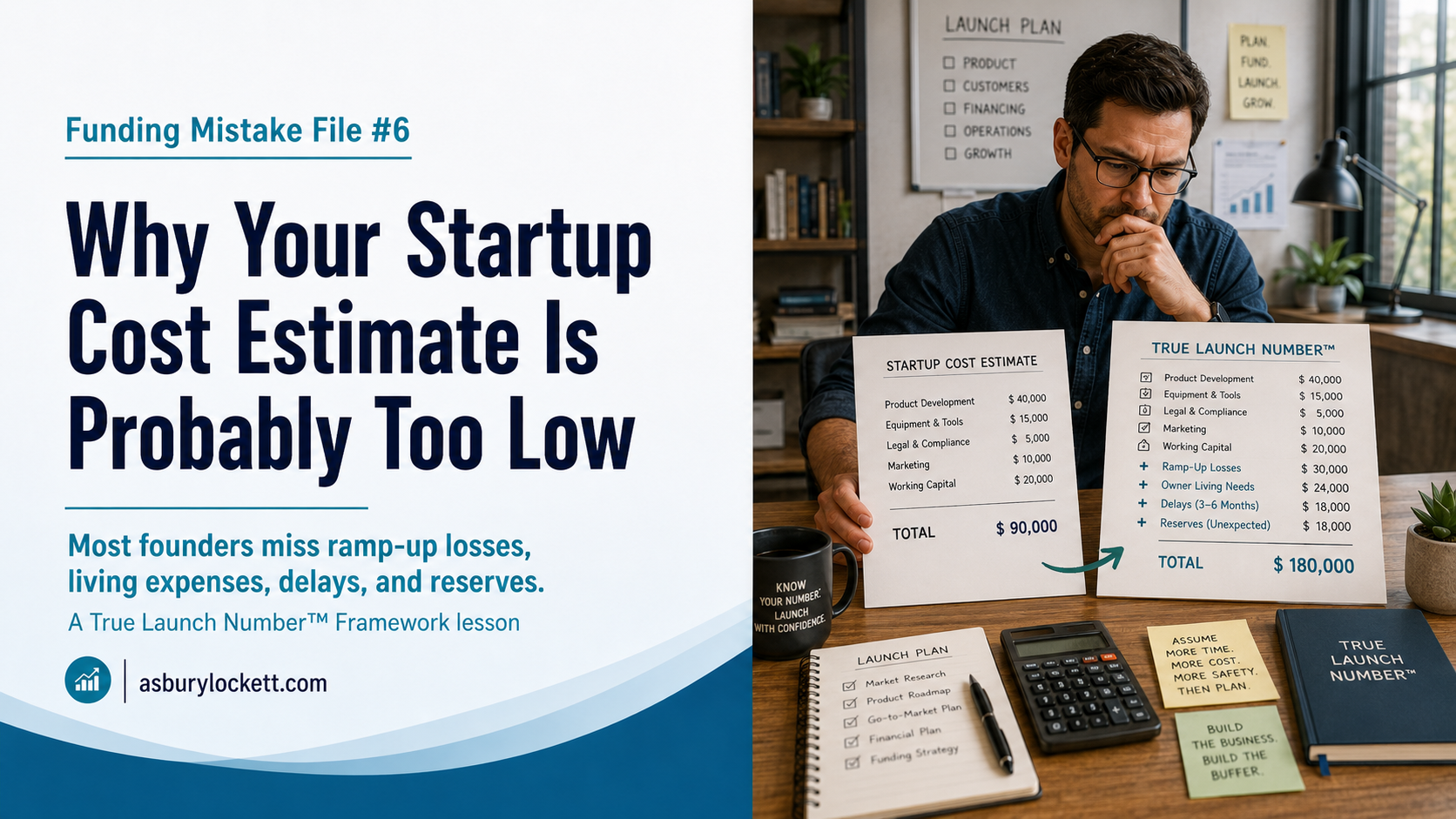
Lesson: Most founders miss ramp-up losses, living expenses, delays, and reserves.
Author’s Note: The story below is fictional, but it is inspired by real patterns I have seen while advising small business owners. Names, industries, locations, dollar amounts, and other details have been changed, combined, or fictionalized to protect confidentiality.
Most first-time founders do not intentionally underestimate their startup costs. They simply estimate the costs they can see.
They list the obvious items: rent deposit, equipment, inventory, website, logo, business registration, insurance, signs, supplies, software, furniture, permits, and opening marketing. Those items matter, and they should be included. But they are usually only part of the real funding need.
The hidden danger is that many founders stop the estimate too early. They calculate what it takes to get the business ready to open, but not what it takes to keep the business alive while sales ramp up, customers develop trust, systems improve, mistakes get corrected, and the owner survives financially.
That lesson became clear for a fictional founder named Teresa, who launched a mobile IV hydration and wellness service. She had professional experience, strong demand signals, and a thoughtful service concept. But her startup cost estimate missed several categories that became critical once the business moved from idea to reality.
1. The Founder’s Dream
Teresa had worked for years as a registered nurse. She was skilled, calm, and comfortable serving people in stressful situations. Over time, she became interested in preventive wellness, hydration therapy, and services that helped busy adults recover from travel, fatigue, athletic events, and demanding schedules. She noticed that mobile wellness services were becoming more familiar to consumers, and she believed there was room for a professional, safety-focused provider in her local market.
Her dream was to build a mobile IV hydration and wellness service that served clients at home, in hotel rooms, at small events, and through partnerships with fitness studios, wellness centers, and concierge providers. She wanted the business to feel clinical enough to be trusted, but personal enough to feel convenient and approachable. Her long-term vision included a small team of licensed providers, recurring wellness packages, and partnerships with event planners and hospitality businesses.
Teresa began preparing carefully. She researched legal and regulatory requirements, spoke with insurance providers, priced medical supplies, designed service packages, created a brand identity, built a website, and looked into scheduling software. She also explored medical oversight requirements and professional protocols. Compared with many founders, Teresa was serious and detail-oriented.
When she created her startup cost estimate, she included business formation, insurance, website development, branding, medical supplies, mobile equipment, uniforms, software, professional fees, marketing materials, and launch advertising. She estimated that she needed approximately $55,000 to open responsibly. Between savings, a small personal loan, and credit cards, she believed she could cover that amount.
Her estimate was not random. It was based on real items.
But it was still too low.
2. The Mistake
Teresa’s mistake was that her startup cost estimate focused mostly on launch readiness, not launch survival. She had estimated what it would take to be legally, operationally, and professionally ready to offer services. But she had not fully estimated what it would take to reach break-even.
She missed four major categories.
First, she underestimated ramp-up losses. Teresa assumed that once the website launched and local marketing began, appointments would build steadily. But customers needed time to understand the service, compare providers, trust the brand, and decide whether the price made sense. Partnerships also took longer than expected. Fitness studios wanted to observe demand before promoting her. Hotels required internal approval. Event planners liked the concept but did not immediately have events that fit.
Second, she did not include enough owner living support. Teresa expected to reduce her nursing shifts and dedicate more time to the business. But the business could not pay her meaningfully in the early months. Her household expenses continued, and the personal income gap became a source of pressure.
Third, she underestimated delays. Insurance approvals, supplier setup, medical oversight arrangements, payment processing, website revisions, and marketing materials all took longer than expected. Some delays were only a week or two, but each delay affected revenue timing. Expenses began before steady income arrived.
Fourth, she did not include enough reserves. She had a small cushion, but not enough for unexpected costs: supply price changes, a software upgrade, additional legal review, a damaged piece of equipment, higher-than-expected ad costs, and slower customer acquisition.
Her estimate answered the question, “What do I need to be ready to operate?”
It did not fully answer, “What do I need to survive until the business can support itself?”
3. The Impact
The business launched professionally, but revenue grew slowly. Teresa received compliments on the website, and people responded positively to the concept. She booked several appointments in the first month, but not enough to cover her full monthly costs. Some potential customers asked questions and then disappeared. Others said they would book “after their next trip” or “before their next event.” Several local businesses expressed interest in partnership conversations, but those conversations moved slowly.
The early months were not empty, but they were uneven. One weekend might bring multiple appointments, followed by several quiet weekdays. A small event might generate good revenue, but events were not consistent. Teresa found herself spending significant time educating customers about the service, explaining safety procedures, answering pricing questions, and following up with leads who were interested but not yet ready.
Meanwhile, expenses continued. Insurance, software, marketing, supplies, professional oversight, phone service, transportation, payment processing, bookkeeping, and loan payments all required cash. Teresa also needed to maintain enough inventory to serve clients quickly, but carrying supplies tied up money before appointments were booked. She learned that being available for service required upfront readiness, and readiness cost money.
The personal pressure grew as well. Teresa had reduced some nursing shifts to build the business, but the business income did not replace those wages quickly. She began using personal savings for household expenses while also trying to protect business cash. That created tension. She needed to market more aggressively, but she was worried about spending more money. She needed to attend networking events and build partnerships, but those efforts took time away from paid nursing work.
By month four, Teresa realized that her original funding estimate had not been enough. The business was not hopeless. In fact, customer feedback was positive and the model still had potential. But her cash position was too tight. The estimate had missed the cost of time.
She had funded the setup.
She had not fully funded the runway.
4. The Better Path
A True Launch Number™ analysis would have helped Teresa create a more complete estimate before launching. The goal would not have been to scare her away from the business. The goal would have been to reveal the real funding need early enough to make better choices.
The first step would have been to keep her startup cost list, but treat it as only one part of the calculation. Business formation, insurance, supplies, branding, website, software, professional fees, and launch marketing were all necessary. But they were not the whole story.
The second step would have been to estimate ramp-up losses. Teresa could have built a conservative sales forecast showing slow appointment growth during the first six to twelve months. She could have asked: What if I book only five appointments in month one? What if partnerships take six months to develop? What if events are seasonal? What if paid advertising takes testing before it becomes efficient? Those questions would have shown the likely monthly losses before break-even.
The third step would have been to include owner living needs. If Teresa needed $4,000 per month to support her household and planned to reduce her nursing income, that gap needed to be part of the launch plan. Owner needs are often uncomfortable to include because they feel personal, but they directly affect business survival. A founder under household financial pressure may make rushed decisions, cut marketing, underprice services, or give up too soon.
The fourth step would have been to build in time and delay reserves. If the business launch depended on approvals, suppliers, professional oversight, partnerships, or specialized insurance, delays should have been expected. A reserve does not mean the founder is pessimistic. It means the founder understands that real launches rarely unfold exactly on schedule.
The fifth step would have been to create a cash reserve for unexpected problems. Every startup needs some room for mistakes, repairs, price increases, weak marketing tests, slower sales, and unplanned expenses. Without reserves, every surprise becomes an emergency.
Once Teresa included those items, her True Launch Number™ might have looked very different. Instead of $55,000, the real number might have been $85,000, $100,000, or more. That larger number would not automatically mean she should raise all of it and launch immediately. It might mean she should keep more nursing income during the first year, launch more slowly, pre-sell wellness packages, secure stronger partnership commitments, reduce fixed monthly costs, or delay certain expenses until demand was proven.
A better estimate gives the founder choices.
An incomplete estimate creates surprises.
5. The True Launch Takeaway
Your startup cost estimate is probably too low if it only includes the costs required to open. Most founders miss the less visible categories: ramp-up losses, living expenses, delays, and reserves. Those categories may not be as exciting as equipment, branding, inventory, or a beautiful launch, but they often determine whether the business survives long enough to reach break-even.
Teresa’s story is a reminder that a careful founder can still underestimate the capital need. The problem is not always sloppy planning. Sometimes the problem is incomplete framing. If the question is too narrow, the answer will be too low.
The True Launch Number™ Framework expands the question. Instead of asking only, “What will it cost to start?” it asks, “What will it cost to move from idea to launch to break-even?” That broader question includes the cost of time, uncertainty, learning, adjustment, owner survival, and cash protection.
Before launching, founders should ask: How long will sales realistically take to ramp? What expenses continue during that period? What personal income does the owner need? What delays are possible? What reserve is needed if the first plan does not work exactly as expected? What funding gap remains after current resources are counted?
Those questions help turn an optimistic estimate into a survivable plan.
Before you trust your startup cost number, test what it leaves out.
Before you launch, include the cost of getting to break-even.
Before you move forward, know your True Launch Number™.
Next Step
Want to avoid this mistake in your own startup?
Download the free True Launch Number™ Checklist to begin identifying your startup costs, monthly expenses, early operating losses, owner needs, cash reserves, and funding gap before you commit to a launch plan.
For a deeper step-by-step process, my book, Securing Small Business Startup Funding, walks first-time founders through how to calculate the real amount of capital needed to move from idea to launch to break-even.
