How to Think About Runway Before You Launch
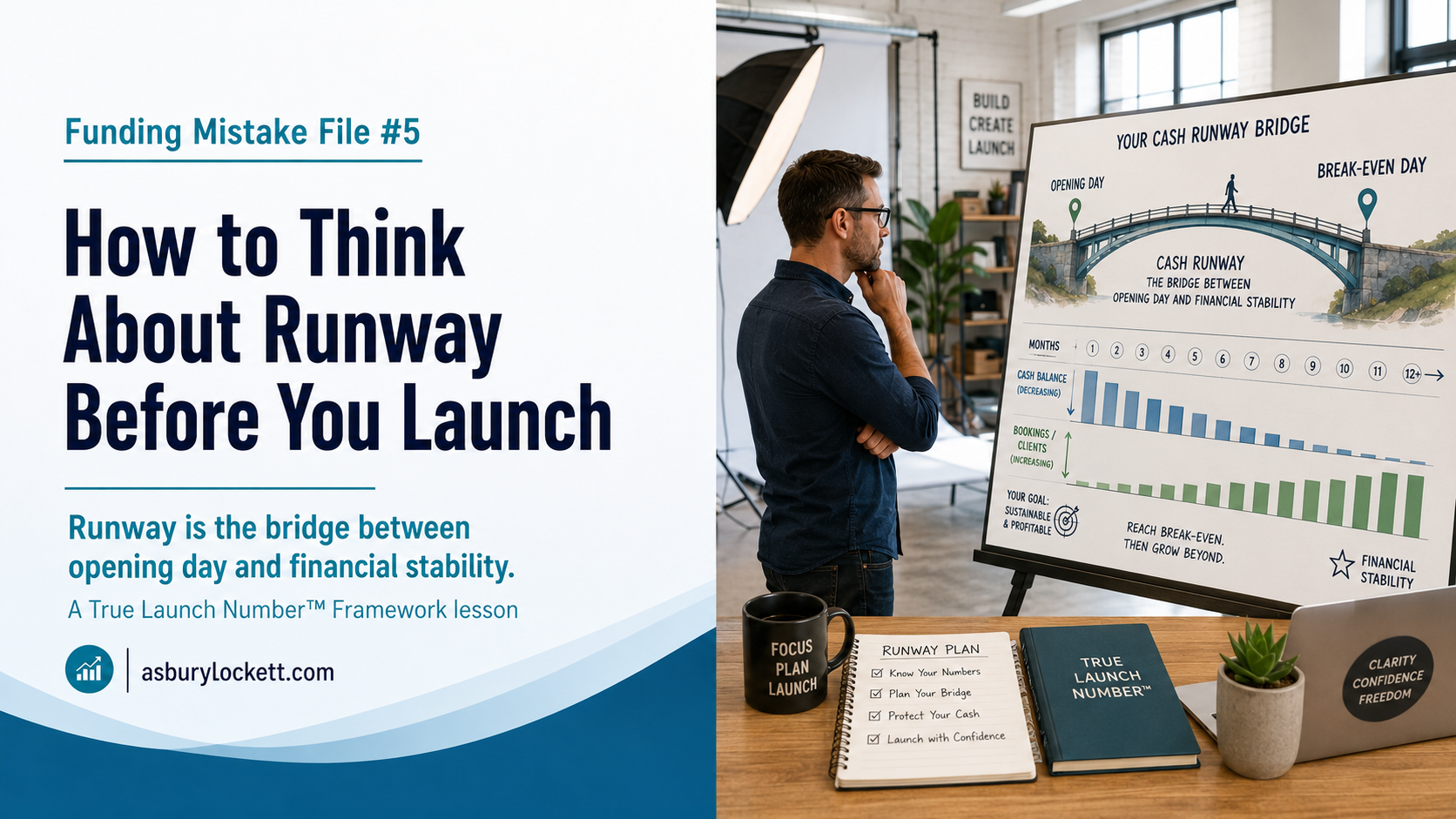
Lesson: Runway is the bridge between opening day and financial stability.
Author’s Note: The story below is fictional, but it is inspired by real patterns I have seen while advising small business owners. Names, industries, locations, dollar amounts, and other details have been changed, combined, or fictionalized to protect confidentiality.
Many first-time founders think about launch as a moment. The grand opening. The first customer. The website going live. The first order. The first appointment. The first day the business becomes real.
But launch is not just a moment. Launch is a period of time.
After opening day, the business still has to attract customers, deliver consistently, adjust pricing, improve operations, test marketing, build repeat sales, manage expenses, and move toward break-even. During that period, cash may be leaving faster than it is coming in. That is why runway matters.
Runway is the bridge between opening day and financial stability. It is the amount of time the business can continue operating before cash runs out. The longer and stronger the runway, the more time the founder has to learn, adjust, and grow. The shorter the runway, the more every mistake becomes dangerous.
That lesson became clear for a fictional founder named Rachel, who opened a small photography and content studio for entrepreneurs, creators, and local businesses. She had talent, a beautiful space, and a real market opportunity. What she did not have was enough runway to give the business time to stabilize.
1. The Founder’s Dream
Rachel had been a photographer for years. She started by taking portraits for friends, then gradually expanded into branding photos, product shots, event photography, and social media content for small businesses. She enjoyed helping entrepreneurs look more professional online. A good photo session could make a consultant, coach, baker, boutique owner, real estate agent, or handmade product seller feel more confident and credible.
As more business moved online, Rachel noticed a growing need. Small business owners needed photos, short videos, product images, website visuals, and social content, but many did not know how to create those assets themselves. Renting professional studios was expensive and intimidating. Hiring a large agency was beyond the budget of many small operators. Rachel imagined creating a more approachable studio where local entrepreneurs could book affordable branding sessions, product photography days, content packages, and seasonal mini-sessions.
Her dream was to build a bright, flexible content studio with simple backdrops, natural light, props, product tables, a small video area, and room for workshops. She could serve individual clients, host content days for groups, and rent the space to other photographers during unused hours. The studio would also help her appear more established than working from client locations or borrowed spaces.
Rachel found a small creative loft with good windows and reasonable access. The rent was higher than she wanted, but the space photographed beautifully. She imagined the launch photos, the client sessions, the workshops, and the social media buzz. She used savings, a small personal loan, and credit cards to cover the deposit, first month’s rent, paint, furniture, lighting, backdrops, props, insurance, branding, website updates, and opening marketing.
When the studio opened, it looked exactly as she hoped. Her launch photos were beautiful. Friends and past clients congratulated her. Several people commented that the studio was “exactly what local small businesses needed.”
Rachel had created a space that people admired.
But admiration was not the same as enough runway.
2. The Mistake
Rachel’s mistake was that she planned carefully for the studio opening, but not carefully enough for the months after opening. She assumed that because the concept was strong and her existing network was supportive, bookings would grow quickly enough to cover the studio’s monthly costs.
Her estimate included the cost to prepare the space. It did not fully include the cost of time.
The studio needed recurring revenue from photo sessions, content packages, space rentals, and workshops. But each revenue stream required customer education and consistent marketing. Some small business owners loved the idea but wanted to wait until they had a website redesign. Others were interested in product photography but needed to prepare packaging first. Some wanted video content but were nervous on camera. Other photographers liked the rental option but already had preferred locations.
Rachel also underestimated the time required to convert interest into paid bookings. A person might comment positively on social media but not book. A business owner might request pricing but delay a decision. A workshop idea might receive interest but not enough paid registrations. A photographer might tour the studio but wait to rent until they had a client who needed that look.
The studio’s expenses were fixed, but demand was still developing.
Rachel had enough cash to open and operate for a few months. She did not have enough cash to support a slower, more realistic path to stable monthly bookings.
That meant her runway was shorter than the business needed.
3. The Impact
The first month felt promising. Rachel booked several sessions with past clients and hosted a small launch event. The photos from those sessions helped promote the studio. She also received inquiries from entrepreneurs, product sellers, and photographers. On the surface, momentum seemed strong.
The second month was quieter. A few inquiries did not convert. One client postponed a session because their website was not ready. A product photography lead decided to wait until the holiday season. A planned workshop did not sell enough seats, so Rachel canceled it to avoid embarrassment and extra costs. The studio still looked beautiful, but the calendar had more open days than expected.
By the third month, cash pressure became real. Rent was due, utilities were due, software subscriptions continued, marketing expenses continued, and credit card payments began to feel heavier. Rachel also needed money for new props, cleaning, minor repairs, and advertising tests. She had hoped to pay herself modestly, but most of the money coming in went back out to cover studio costs.
The short runway began to affect her decisions. She discounted sessions to fill the calendar, even when the lower price did not leave enough margin. She accepted projects outside her core focus because she needed cash. She reduced paid marketing at the exact time she needed more visibility. She postponed outreach to potential referral partners because she was busy managing short-term stress. She also considered renting the studio cheaply to anyone who asked, even if it weakened the brand positioning she had worked hard to create.
The emotional impact was just as serious. Rachel had believed the studio would give her more stability, but it initially created more pressure. Each quiet day felt expensive. Every open slot on the calendar reminded her that rent was still running. Instead of using the first six to nine months to test, refine, and build, she felt forced to make the business work immediately.
The studio had potential.
But the runway was too short for the business to reach that potential comfortably.
4. The Better Path
A True Launch Number™ analysis would have helped Rachel think about runway before signing the lease and opening the studio. Instead of asking only, “Can I afford to open this space?” she needed to ask, “Can I afford the time it will take for this space to become financially stable?”
The first step would have been to calculate the monthly cost of keeping the studio open. That would include rent, utilities, internet, insurance, software, cleaning, marketing, supplies, repairs, debt payments, and owner living needs. Once Rachel knew the monthly cost, she could see how much cash the studio would require even if bookings were slow.
The second step would have been to estimate a realistic booking ramp. Rachel could have created conservative, moderate, and optimistic scenarios. A conservative scenario might assume only a few paid sessions per month at first, limited rental revenue, and slow workshop adoption. A moderate scenario might show gradual growth as referrals, testimonials, and content improved. An optimistic scenario might show strong early demand. Comparing those scenarios would help her understand the cash required if growth took longer than expected.
The third step would have been to calculate runway. If Rachel had $30,000 available after opening and the studio was likely to burn $6,000 per month before reaching break-even, she had roughly five months of runway. If the business realistically needed nine months to stabilize, she had a gap. That gap needed to be solved before launch, not after panic set in.
The fourth step would have been to define the milestones the runway needed to support. Rachel did not just need “more time.” She needed time to reach specific targets: a certain number of monthly sessions, a certain level of rental revenue, a minimum number of recurring business clients, enough workshop registrations, or enough referral partnerships. Runway is most useful when it is connected to clear milestones.
The fifth step would have been to redesign the launch if the runway was too short. Rachel might have started with a part-time studio rental arrangement instead of a lease. She could have pre-sold content packages before committing to the space. She could have secured agreements with photographers who wanted rental access. She could have launched quarterly content days from borrowed spaces while building demand. She could have kept more outside photography income during the first year. She could have chosen a smaller space or negotiated free rent during the build-out period.
A better runway plan would not have guaranteed success, but it would have given Rachel more time to make smart decisions. With adequate runway, a quiet month becomes information. Without adequate runway, a quiet month feels like a crisis.
Runway gives the founder room to learn.
Without it, the business must be right too quickly.
5. The True Launch Takeaway
Runway is the bridge between opening day and financial stability. It is the cash cushion that allows a founder to survive the early months while customers discover the business, marketing is tested, pricing is adjusted, systems improve, and revenue moves toward break-even.
Rachel’s story is a reminder that a strong launch is not the same as a stable business. A founder can receive compliments, inquiries, social media engagement, and early customers while still lacking enough runway. The question is not only whether people like the idea. The question is whether the business has enough time and capital to turn that interest into reliable revenue.
The True Launch Number™ Framework helps founders think about runway before they commit. It asks the founder to estimate startup costs, monthly burn, early losses, owner needs, sales ramp, reserves, and break-even timing. Those pieces reveal whether the business has enough capital to cross the bridge from opening day to financial stability.
Before launching, every founder should ask: How much cash will we have after opening? How much will we burn each month before break-even? How many months of runway does that give us? What milestones must we reach before the runway ends? What will we do if sales grow more slowly than expected?
Those questions help the founder see whether the launch plan is strong enough, too expensive, too fast, or too dependent on immediate sales.
Before you open the doors, know how long your cash will last.
Before you commit to fixed costs, know what milestones your runway must support.
Before you launch, make sure your True Launch Number™ includes the bridge to break-even.
Next Step
Want to avoid this mistake in your own startup?
Download the free True Launch Number™ Checklist to begin identifying your startup costs, monthly expenses, early operating losses, owner needs, cash reserves, and funding gap before you commit to a launch plan.
For a deeper step-by-step process, my book, Securing Small Business Startup Funding, walks first-time founders through how to calculate the real amount of capital needed to move from idea to launch to break-even.
